Circadian Influences on Selection Accuracy in Equine, Greyhound, and Team Sport Markets
Written by Bianca Schulz · Oct 29, 2026

Circadian Influences on Selection Accuracy in Equine, Greyhound, and Team Sport Markets
Circadian rhythms regulate core body temperature, hormone levels, and muscle function in both animals and humans, and researchers have documented how these daily cycles affect performance outcomes in equine racing, greyhound competitions, and team sports events. Data from performance logs indicate that horses often reach peak speed during late afternoon hours when their internal clocks align with optimal metabolic states, while morning races may show reduced stride efficiency in certain breeds.
Equine Performance Patterns
Studies tracking thoroughbreds across multiple tracks reveal consistent variations tied to race times, with afternoon events producing higher average speeds compared to early morning slots because cortisol and adrenaline levels follow predictable daily rises. Observers note that greyhound handlers adjust training schedules to match these peaks, yet betting models that overlook the timing factor frequently misjudge win probabilities by several percentage points.
Greyhound Racing Dynamics
Greyhounds exhibit similar time-of-day sensitivities, according to physiological monitoring conducted at Australian racing facilities where body temperature readings peak between 2 p.m. and 6 p.m. local time. This alignment correlates with faster trap-to-finish times in evening meetings, and analysts who incorporate these cycles into selection algorithms report improved accuracy rates when distinguishing between day and night fixtures.
Team Sport Applications
Team sports display parallel effects because player reaction times and decision-making accuracy fluctuate with circadian phase, and league data from North American and European competitions show evening games often feature higher scoring outputs than early afternoon matches. Researchers at the National Institute of General Medical Sciences have outlined how melatonin onset in the evening can either enhance focus or introduce subtle coordination lags depending on individual chronotypes.
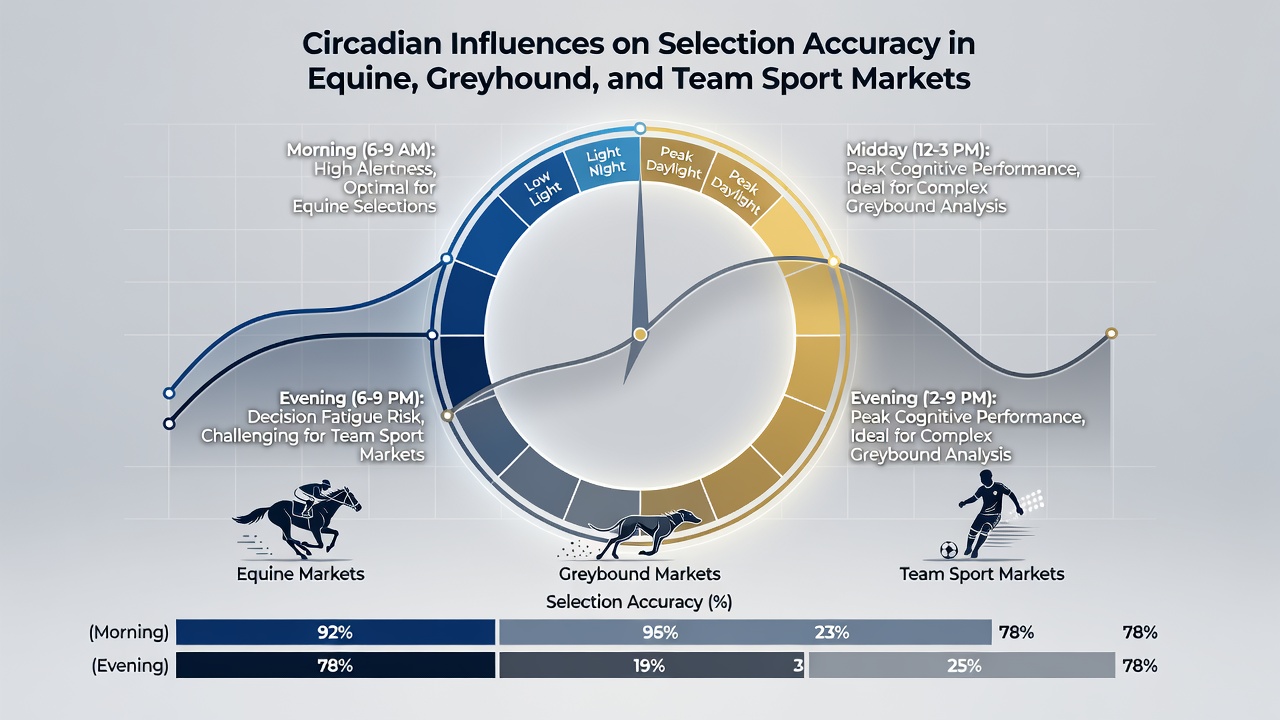
Market analysts who cross-reference fixture start times with established circadian profiles gain an edge in identifying value bets, particularly when travel across time zones disrupts an athlete's or animal's normal rhythm. In October 2026 several major equine and greyhound festivals fall during periods when daylight saving adjustments shift race cards later into the evening, creating measurable shifts in historical performance distributions that models must account for.
Selection Accuracy Metrics
Figures from multi-year datasets compiled by sports science groups demonstrate that selections ignoring circadian variables achieve lower success percentages than those adjusted for time-of-day effects, with error margins widening during atypical scheduling windows such as early morning equine trials or late-night team events. Bettors who integrate these biological patterns with other variables like track conditions and squad composition produce more consistent returns over extended periods.
Canadian research institutions have published reports on how jet lag compounds circadian misalignment in traveling teams, and these findings apply directly to international fixtures where equine shipments or greyhound movements cross multiple zones. Selection accuracy improves when models weight recent travel history alongside standard performance statistics because recovery timelines vary predictably with departure and arrival clocks.
Practical Integration in Markets
Industry reports from the European Gaming and Betting Association highlight growing interest in circadian-adjusted forecasting tools, while university-led studies continue to refine algorithms that predict performance drops during off-peak circadian windows. Those who apply these insights across equine, greyhound, and team sport markets observe tighter correlation between predicted and actual outcomes compared with unadjusted baselines.
Conclusion
Circadian influences on performance create measurable differences in selection accuracy across equine, greyhound, and team sport betting markets, and ongoing data collection from diverse geographic regions continues to refine how these biological factors integrate with existing predictive frameworks. Observers note that models incorporating time-of-day variables alongside traditional metrics deliver more reliable probability estimates when applied consistently to scheduled events.